Chapter 9
“The Padishah feudal structure was stable only insofar as there existed a balance of power among ambitiously antagonistic forces. Constant distrust and the willingness to resort to any means remained the price of security.” - Dune Encyclopaedia
The Heighliner tore through the sky like lightning. For House Varmoth, the journey to Kaitain was not mere travel but a movement of intent—an argument presented in motion. Beneath the hull and inscrutable engines, the party carried the brittle heart of a claim: they had been entrusted with spice operations and now must explain why spice had trickled rather than poured. Each of them kept a private ledger of guilt and remedy. In their minds, the same tally was written in different ink—science and subterfuge, duty and the hunger for reputation.
Corrinth City rose in the windows of their shuttle like an assertion of geometry: towers that held the Imperial will, banners that announced alliances like heraldry in motion as the Varmoth Death Moth fluttered alongside the Corrino Lion. The platform’s trumpets already sounded a welcome that was equal parts ceremony and judgement. Princess Josifa, young and composed, stepped forward as court and courtesy combined. Beside her, the Reverend Mother Montemagni moved with a measured cruelty of gait and a precise interest that took inventory of the living as an archivist takes inventory of relics. Kleya signalled the Reverend Mother with the silence of a Bene Gesserit—hands and eyes trading the soft grammar of sisters—and received in return a small, cold condolence for the late Count Leopold.
The Residency was an arrangement of opulence and observation. Its windows looked down on Corrinth as one might look down on a chessboard: pieces no less cunning because they looked comfortable. Jain and Lela, perfect in their service, were guardians of itinerary and also of the palace’s hidden ear. Hassan, delighted to teach the Corrino servants the ceremonial thunder-snap of Varmoth bed-making, performed a hospitality that was also a probe. He spoke of tradition and the Servant’s place; he taught the crack of linen like one teaches a child to speak. While hands learned thunder, Lundrak learned silence. He found spy-eyes with too little difficulty—some planted for House Varmoth to discover, others planted to be discovered only by a more patient eye. He crushed the obvious ones for theatre and left the intimate ones hidden behind subtly positioned furniture. Where their enemies thought they had planted bugs, Lundrak planted his judgement instead.
Lavro moved in the arc of the analytic mind—patterns seeking cause. He had brought to Varmoth a device of thought and function, a super-thumper grafted from Fremen lore and intricate knowledge of technology, luring the great worms from harvesters and protecting the fragile commerce of spice. He had to speak to the Directorate without speaking of desert oaths or desert brothers. So he practised omission: the truth reduced to utility. “Sabotage,” he would later say, and the room would accept the word because it satisfied a ledger and absolved complicity.
Dali, who had dressed himself as a servant to dissolve attention, tasted Caladonian wine and smiled with the appetite of a man who keeps his curiosity close to his palms.
Lundrak, in the shadows between music and conversation, moved like a needle: he took information and, when it had been wrung dry of usefulness, he cut out the source. He had used Verite and a sharpened mind to extract truths that would not be allowed to survive. He kept himself clean by compartmentalising the deaths; House Varmoth was, to him, hygiene.
The opera-house night was theatre within theatre. The Hassik III Centre for the Performing Arts’ vastness swallowed sound and returned it as jurisprudence—every whispered hint of favour or threat would reach the balconies as doctrine.
In the private box, Lavro found a purse left in deliberate proximity—left, as the mind of a man who views things as nodes, a test for attention. Dali distracted and charmed the omnipresent Jain with complaint turned friendship, opened paths that were not supposed to exist. This gave Lavro the chance to look inside the purse: a security key, a programme, and a name—Lady Magnolia Kae. When she smiled as she passed, Lavro took the smile for what it might be—entrance.
Padishsh Emperor Shaddam Corrino IV arrived late, for lateness was also a manner of measure; presence weighed more than punctuality. His applause consecrated House Varmoth as a curiosity and, for a moment, as an asset. The Emperor proclaimed, “Tonight we have some honoured guests! I warmly welcome House Varmoth to Kaitain. They have bright their expertise to Arrakis and have become a worthy addition to the spice mining operations for some time now! Now please all enjoy the show, so expertly curated by House Morgan!”
The production, macabre and comic, fed the Court the legend of Corrino supremacy in laughter and staged blood: an entertainment that taught history and smoothed conscience.
Later at the evening reception, Lavro approached Lady Kae, who suggested they talk somewhere more private. Hassan saw that a distraction was needed and, with the modest, officious courage of the servant who is a spy’s apprentice, steered Lela away with manufactured alarm and thus cleared a line for Lavro.
The Mausoleum was the wrong place for candour. Between transparent coffins and urns, a man can be judged in another register—what survives of a name and what survives in silence. Lady Kae did not wait; instead, Alexzander Harkonnen stepped from the shadow where she should have stood. He spoke in a voice warning of an uncovered threat, repaying the debt owed with information: House Varmoth was marked, the Harkonnens had a plan to discredit and displace them. He slid words like a blade, and the air tasted of iron.
Suddenly, a metallic sound rang throughout the Mausoleum. The Reverend Mother Montemagni appeared, her cane tapping loudly on the stone floor. Alexzander was gone. She questioned why Lavro was down here and beckoned him back to the Ball; Lavro obeyed. As they walked back, Lavro was fascinated by the null-entropy fields that sealed the tombs, and the Reverend Mother explained the Ixian technology.
Back at the after-party, the observation deck thrummed with courtly predators. Lundrak floated to Lord Morgan and, with the practised economy of a man who trades in influence, persuaded the Lord to consider the marriage of his daughter to Count Lucar as a political union of their Houses to strengthen both. Morgan, who had risen on information rather than industry, listened as one who kept receipts of scandal. He would find dirt on Alexin, he promised. Promises at Court are currency, and Lundrak collected them.
The morning after at the Contemplation Tea House was a lesson in private light. The gardens there are arranged so that the right conversation is inaudible to all but the intended ear. Count Fenring found them not by accident; he always finds what men hope to hide. He spoke in stuttering, deliberate halves—an assassin’s smile under a friend’s hand. Fenring foretold a plot—Godwyn Alexin would move to bring a no-confidence vote. He suggested support or else face a fate that would be humiliating for the Emperor and ruinous for them. Fenring’s counsel came with that peculiar intimacy of one who knows how the body of Empire might be opened for a sword.
Lady Caranda Ecaz approached the table like an accusation of elegance. Kleya read her like a book, noting her Bene Gesserit training.
Lady Ecaz brought out a deck of Tarot cards and shuffled the cards loosely, with a wavering but practised grasp.
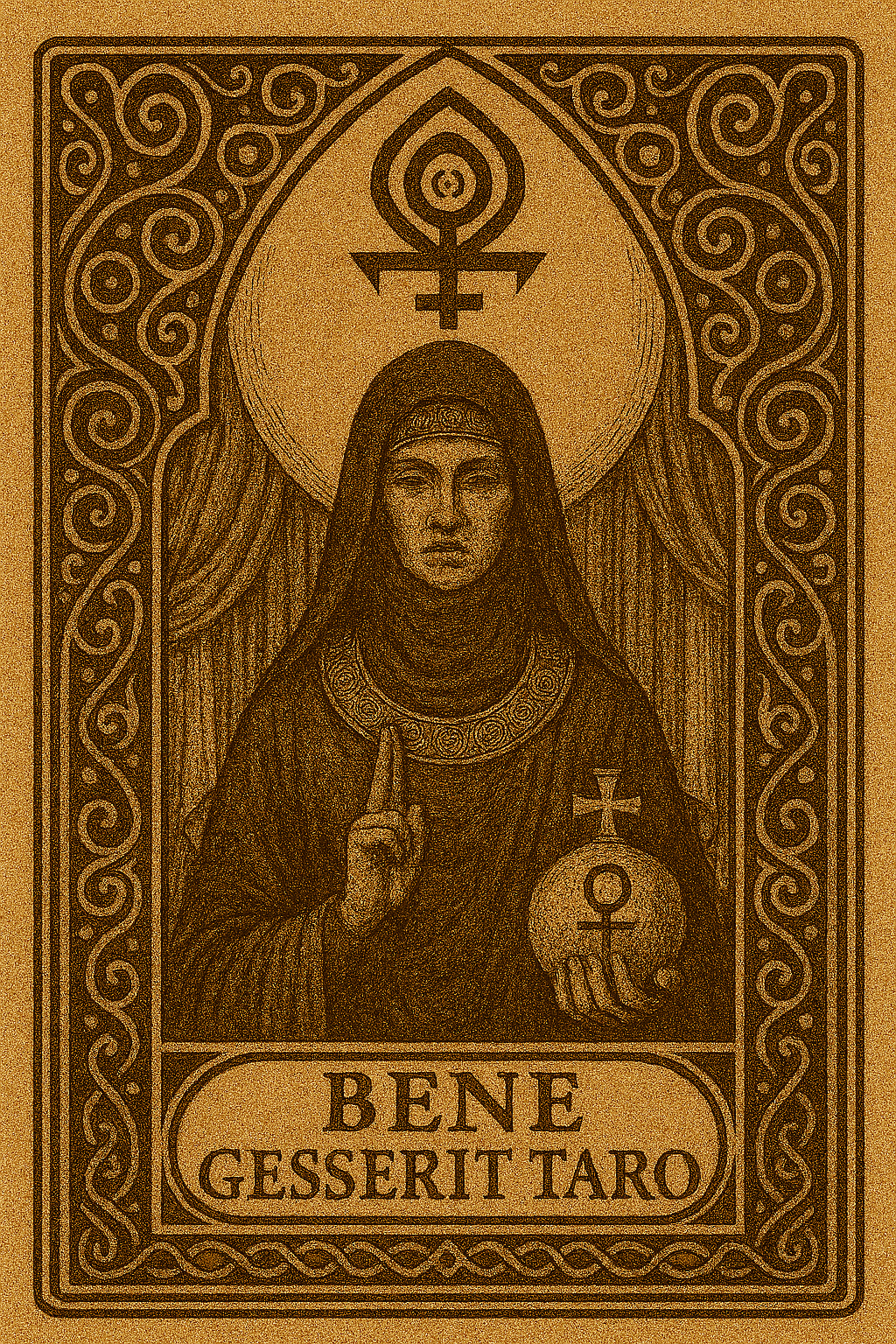
She explained: “I know that these are somewhat of a superstition, but I have found that the cards often provide non-intuitive insights and the seeming patterns that emerge to be quite useful. I turned to them often in my convalescence, and they brought me great comfort. Please…”
She asked Kleya to cut the cards for her into three groups, then to stack them again. “The first card represents your past.”
She drew the first card:
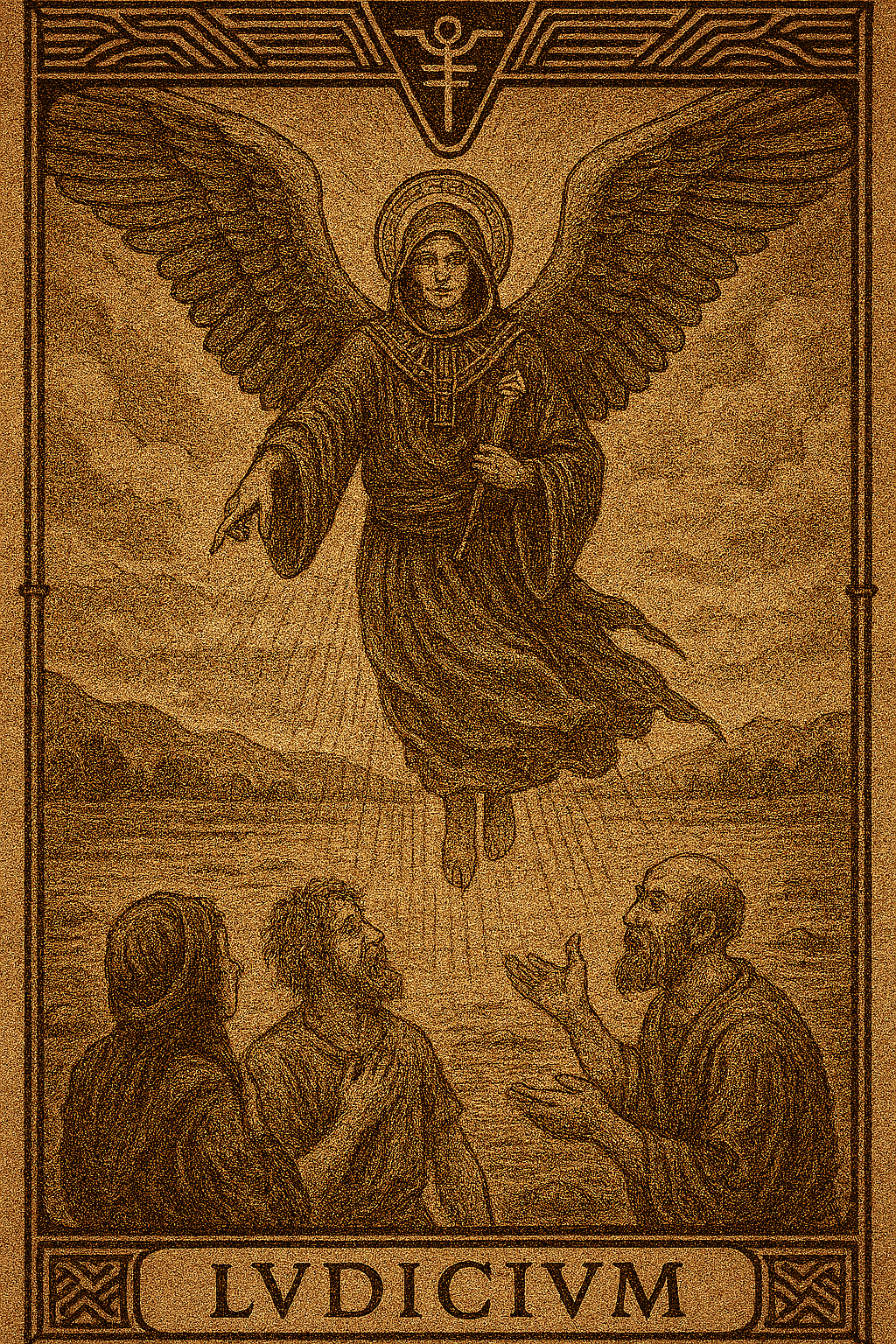
“This is ‘Iudicium’. Judgment… but reversed.” she reads, the card depicting a roiling cloud above a verdant plain, some sort of angelic being looking down from afar, beckoning to what look like peasants gathered below, looking at one another. “You were given an opportunity to prove yourself, a great honour bestowed upon you, yet the reversal means that many sought you to fail. It is possible, even, that the one who put the test before you was not an advocate for your success. But this, I think, you know, or should at least suspect.”
“Draw the second card.”
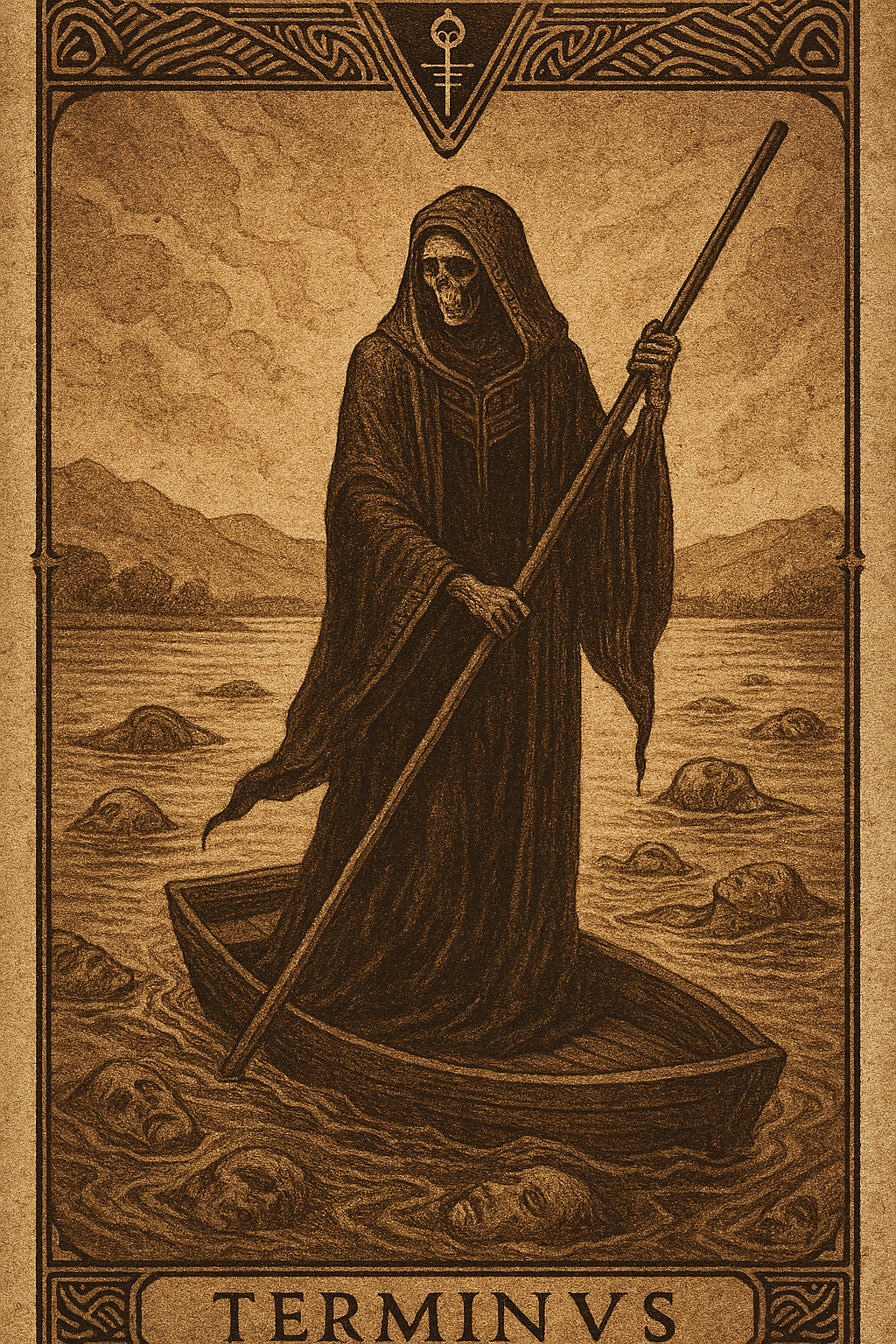
The card revealed a gaunt figure, almost skeletal, swathed in a billowing black robe and hood. It stands upon a small boat on a river, the shore visible in the distance, navigating by the use of a long pole. Corpses float in the water around the boat. “Your current circumstances: ‘Terminus’, or Death. A grim card, but also one of transformation. You have faced great loss, and yet you are changed, growing to accommodate this tragedy. The other shore beckons, but you are still in the river.”
“A third card, please.”
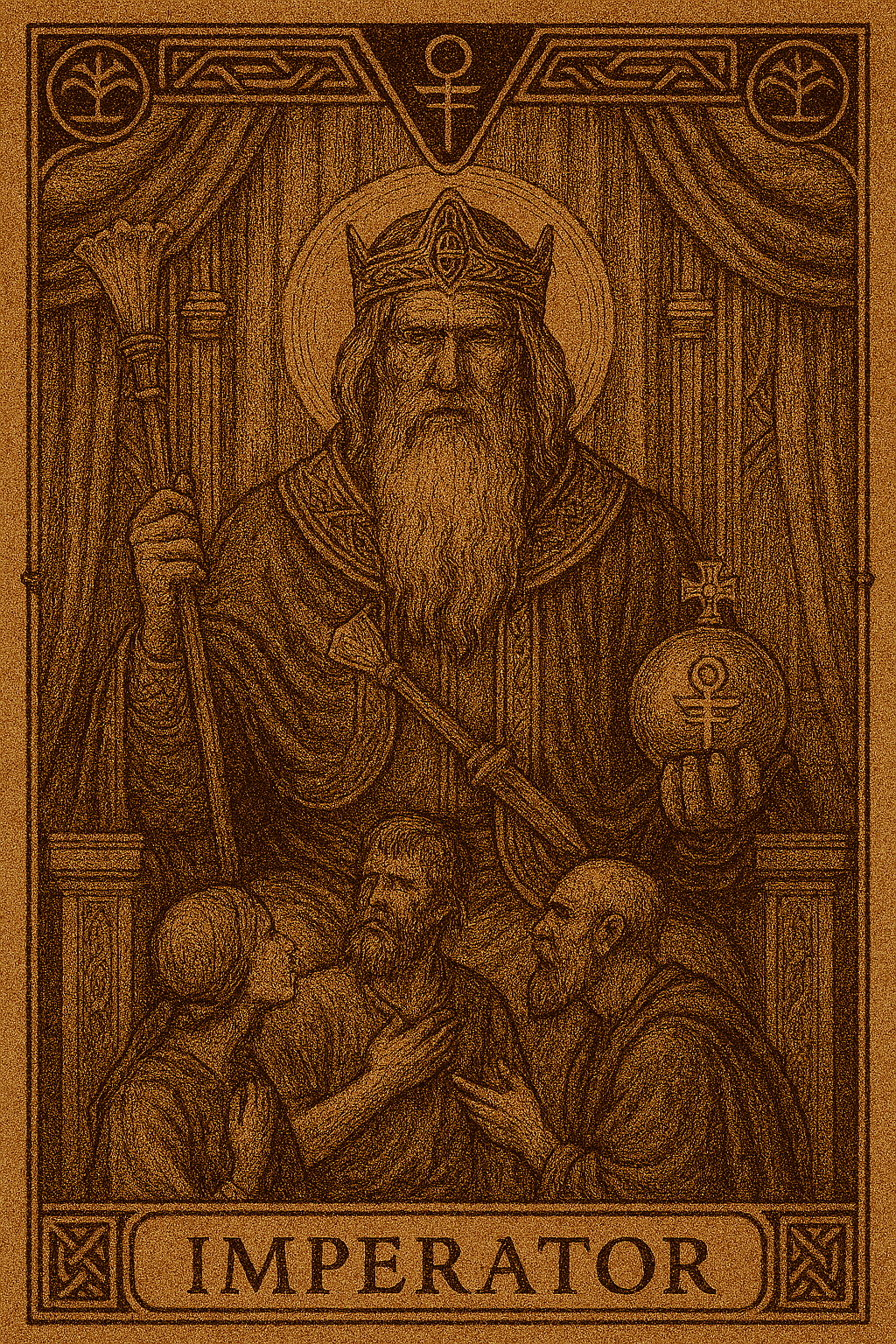
“This depicts that which stands in your future, either that which you must overcome, or that which you must become.” This final card depicts an old man in regal garments, his beard long and white, sitting upon a golden throne, a crown upon his head. In one hand is a bejewelled ball with a small symbol upon it, the other hand holds a short scepter with a flared head, crossed over his breast.
From the position of the card, though, it is upside down. Lady Ecaz’s breath hisses through her teeth. “Imperator. The Emperor. Master of all things. The most formidable opponent one can face, or a grand destiny. But reversed is an interesting position. It implies cunning and deception, perhaps no true path to this state, but also denotes a lack of faith. Perhaps if the Emperor opposes you through proxies, it is part of some greater scheme yet to be revealed. Or perhaps it reveals a hidden ambition for House Varmoth to rule the Imperium.”
She sits back, pushing the rest of the cards aside. “Enough, though. I thirst, then let’s talk business.”
Her proposition was blunt: funds to rebuild House Ecaz to fight Harkonnen; a slice of spice profits in trade. Kleya’s Bene Gesserit reserve met with Ecaz’s wounded candour and produced a negotiation—Ecaz would be given the promise of trade routes for their drugs, supplying the people of Carthag in a way that would hurt Harkonnen interests without overtly implicating the hands of Varmoth or Ecaz.
The party retreated to the residency and prepared for the Royal Ball. The ballgown Kleya chose was not merely a dress but a statement. It was woven of Varmoth moth-silk, the fibres shimmering with the faint luminescence drawn from storm-charged chrysalises. The bodice rose in a sculpted thorax, cinched with a clasp of onyx and lightning-forged silver that resembled an insect’s carapace; small iridescent scales caught the room’s light and broke it into cold rain. From the shoulders sprouted panels cut and pleated to suggest wings, the fringe tipped in thread that twitched with embroidered veins—a mimicry of flight caught in embroidery. Beneath the skirt’s hem, fine chains hid tiny beads that chimed a sound like rain on metal whenever Kleya moved—an audible herald that was both courtly and impossible to ignore. Death moth motifs were scattered across the fabric—stylised eyes that conveyed remembrance, patterns that spoke of metamorphosis. The effect was severe: sorrow and splendour braided together into a single, immovable statement.
At the Ball, the House split itself by design. Hassan approached Henrico Obado, offering contracts in trade: five years at first, and then, when the Earl revealed his aim for a decade’s stretch, Hassan shifted his tact to acceptance and promise. The obsequiousness of the diplomat masked an underlying calculation—the stillsuits proposed would serve the miners in the sands and buy Obado’s vote.
Lundrak, the consummate listener, turned a casual conversation with Lord Morgan into the promise of an introduction between Morgan’s sons and Fabrizi Thorvald. Alliances are often currency disguised as weddings; Lundrak offered both counsel and a conduit. Kleya, speaking to Earl Memnon Thorvald, offered to introduce Fabrizi to Morgan’s eligible heirs—a kindness that had the weight of policy. The Earl, bruised by pride and suspicious of blackmail in Court gossip, warmed to an alliance that promised both dignity and revenge.
Dali found Edwin Hagal in a corner and saw the telltale signs of semuta—yellow skin, red eyes, the small tremor of the addicted. He offered semuta with the economy of someone who knew demand when he saw it; Edwin, hungry and ashamed, took it. The sale was a private theft of virtue—a quiet change of hands that might someday become a lever for blackmail or mercy.
By nightfall, with whispered promises and written guarantees, House Varmoth had secured five pledges: Morgan, Obado, Thorvald, Hagal, and Ecaz. They drank and danced on a precarious ascent.
The next day, the Silver Needle closed its doors, and the Directorate sat. The rules were strict—no outside communication, no exits, meetings to end at dusk. The amphitheatre itself felt like a trial chamber: each speaker a witness, each vote an execution.
When House Varmoth presented the report of their spice mining operations, Lavro’s voice was as Mentat steel—clear, reserved, deliberately incomplete. He spoke of sabotage found in a carryall, of maintenance neglected by hired hands.
Questions came angled like spears. President Aru asked for methods that could be shared. Lavro offered theory and vagueness in equal measure: he would, he said, share improvements with allied Houses once development was complete.
Godwyn Alexin rose and asked, in the blunt language of a man who would topple a rival, what their strategy was for sandworm avoidance. Lavro answered with Mentat pride: a solution near but not yet public. It was a tactician’s answer—enough to satisfy curiosity, not enough to betray advantage: an idea still in testing—a device that would mitigate worm attacks—without ever naming the desert children who had taught him its rhythms or naming the super-thumper that was already humming in partial assembly back on Arrakis.
Count Fenring asked about the curbing of spice smugglers. Lavro’s reply—simple, clean—claimed detection and resolution; Aru reacted as one who keeps the Empire’s revenue like a sacred trust.
Lady Zevara raised the question of dilapidated harvesters; Lavro shifted blame to poor maintenance and sabotage. Lady Vertas insinuated deception, the purchase of new, expensive harvesters—and a whisper of corruption crept, though Lavro denied the skimming of spice.
When Baron Vladimir Harkonnen rose, the room paid closer attention. He reported increased Fremen activity in the deep desert and asked what would be done. Lavro’s answer was a double lie: he spoke of no contract or problem, but also of an eventual need to remove the Fremen.
President Aru called the session to an end, but Godwyn Alexin made a declaration of a vote in the manner of a man confident in the arithmetic of power: House Varmoth’s spice production had been erratic, and their inexperience might jeopardise the supply that fed the Imperium’s great Houses and the geriatric needs of the Landsraad. He proposed a vote of no confidence and the surgical reallocation of mining rights. President Aru sanctioned the vote.
The Imperium would judge House Varmoth not by what they were but by the outcome of this vote, the fate of their House hanging by a Death Moth silk thread.